The largest risks from AI will affect all of humanity.
Current efforts, gaps and building blocks for an international AI governance framework.

The largest risks from AI will affect all of humanity.
Current efforts, gaps and building blocks for an international AI governance framework.
What you can find on this website
Free, in-depth resources for policymakers working at the frontier of international AI governance:
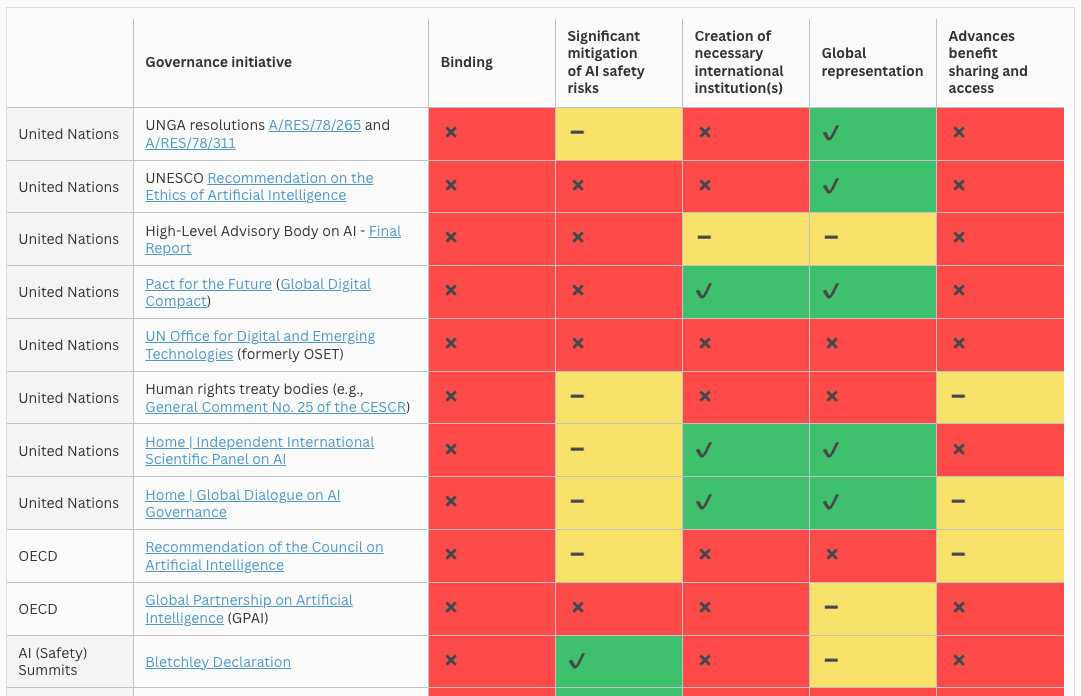
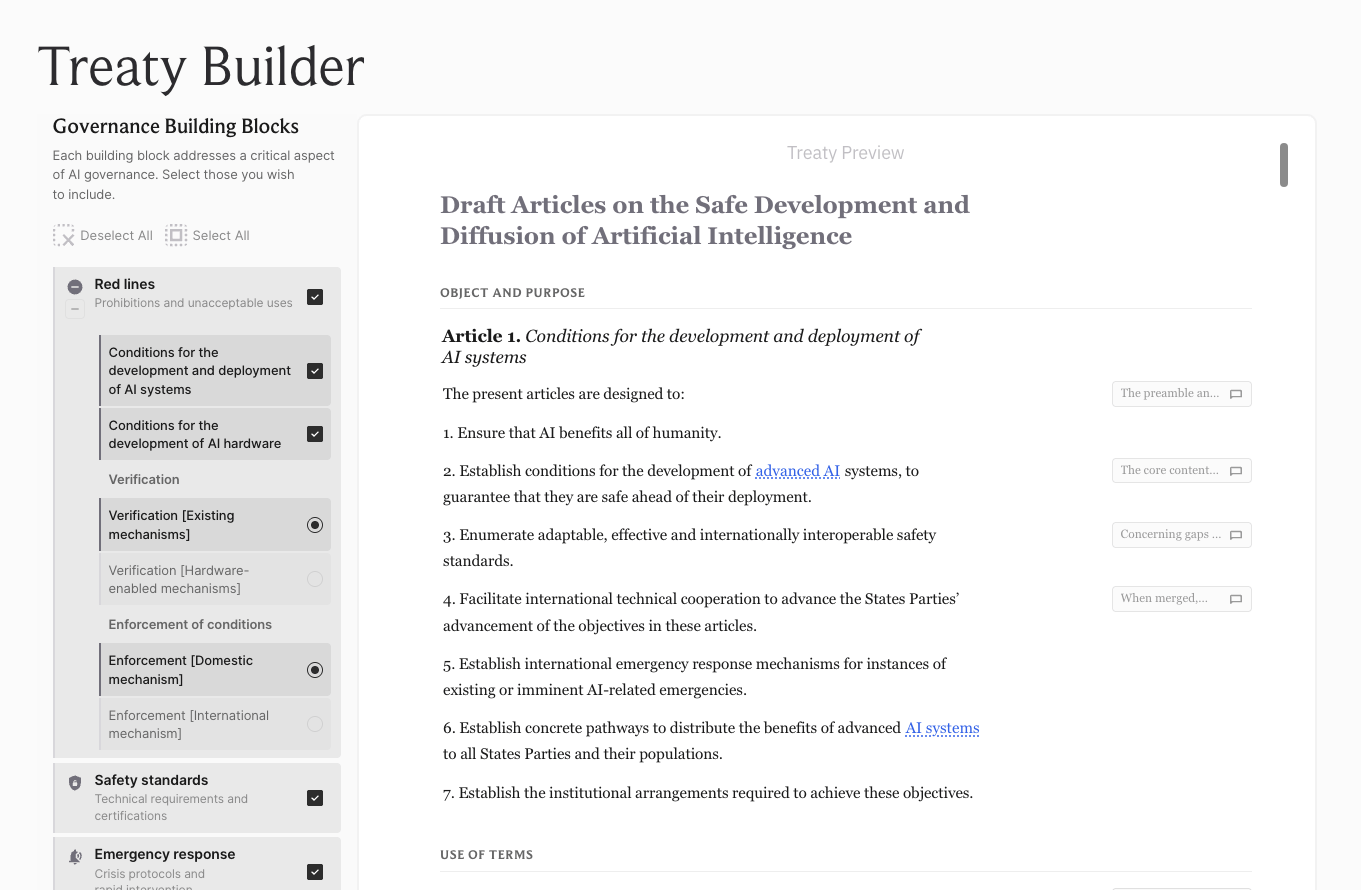
Why do we need global governance for AI?
We need international coordination to ensure the benefits of AI are distributed across the globe. Poor coordination is likely to result in concentration of benefits and power in a small number of hands.
Risks and harms from AI are transboundary–they are not contained to a single jurisdiction and will affect all of humanity as they continue to materialize.
Benefits
Risks
Building blocks for an international governance regime
To reduce the complexity of international AI governance, it is useful to divide it into components or 'building blocks' that can be analyzed in more depth.
Based on the findings of recent comparative analyses of analogous international governance regimes (most notably, Villalobos, Maas and Winter, 2026; Maas and Villalobos, 2023; and Cass-Beggs, Clare and others, 2024), we consider the following building blocks for international AI governance:
Red lines
Safety standards
Technical cooperation
Emergency response
Benefit sharing
Institutional arrangements
Compliance mechanisms
Can Diplomats Save The World Again?
ProHuman: Governing the Global AI Revolution
This podcast addresses questions like:
- What guardrails are needed to ensure AI development is safe and beneficial for all of humanity?
- What are the red lines not to cross, and how can they be enforced?
- How can governments collaborate to create international standards that keep everyone safe?
- And how can the benefits of AI be spread equitably across the globe?
🇬🇧 EN: Insights on international AI policy, multilateral cooperation, and the evolving landscape of AI governance.
🇫🇷 FR : Informations sur la politique internationale en matière d'IA, coopération multilatérale et gouvernance de l'IA.
Recommended reading
View document
View document
View document
View document
View document
View document
Contact Us
Multilateral Governance Team
Future of Life Institute